Learning Objectives
- Identify each region of the vertebral column and its characteristics.
- Compare the general structure of cervical, thoracic, and lumbar vertebrae.
- Locate key features using lab skeletons and 3D tools.
Introduction to the Vertebral Column
The vertebral column—also known as the spinal column or spine—is a flexible, supportive structure that:
🤸 Enables movement🧍 Supports body weight🧠 Protects the spinal cord
How Many Vertebrae?
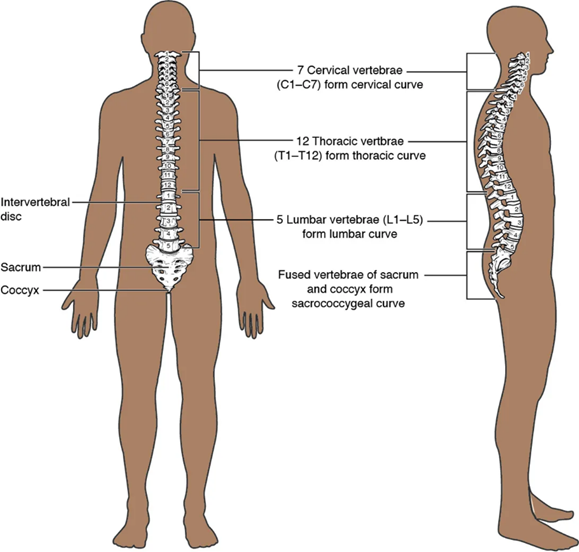
The adult vertebral column is typically made up of 33 vertebrae (occasionally 34). These are grouped into five distinct regions:
| Region | Number of Vertebrae | Notes |
|---|---|---|
| Cervical | 7 (C1–C7) | Supports the head, allows rotation |
| Thoracic | 12 (T1–T12) | Articulates with ribs |
| Lumbar | 5 (L1–L5) | Largest, bears most weight |
| Sacral | 5 (fused) | Forms the sacrum |
| Coccygeal | 4–5 (fused) | Forms the coccyx (tailbone) |
🔍 Note: Only the top 24 vertebrae (cervical, thoracic, and lumbar) are individually moveable. The sacral and coccygeal vertebrae are fused into rigid structures that form the base of the spine.
Use the figure and interactive tools below to gain a spatial understanding of the spine’s regions and curves.
General Vertebral Anatomy
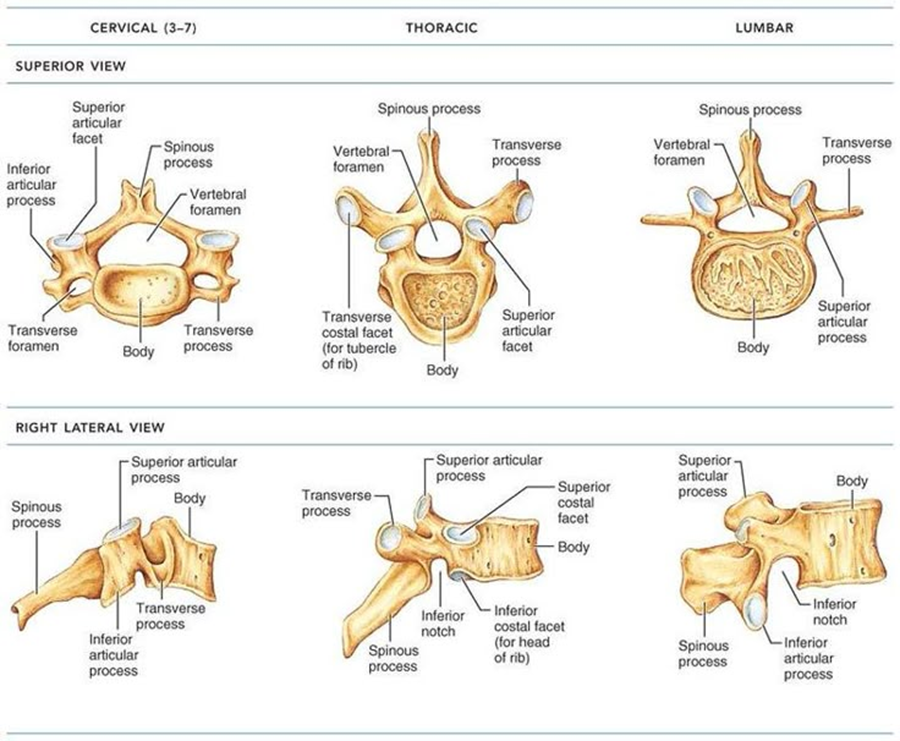
All vertebrae share a common structural plan, though their size and shape vary by region. This section introduces the key features found in most vertebrae and explains their functions. Explore the structure and function of each vertebral region using the interactive tools below
Study the figure below to identify common features on the three types of vertebrae.
🔎 Key Vertebral Structures
Vertebral Body
- The main, load-bearing portion of the vertebra.
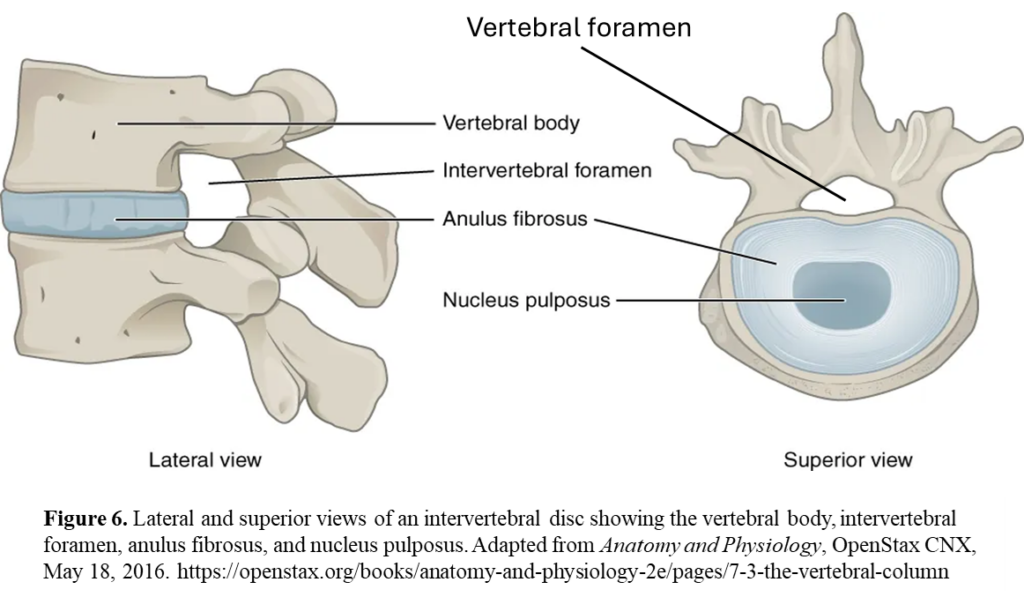
- Bodies are separated by intervertebral discs, which cushion and allow flexibility.
❓ Question: How does the size of the vertebral body change from cervical to lumbar regions?
Vertebral Foramen
- The central opening through which the spinal cord passes.
- Collectively forms the vertebral (spinal) canal for protection and passage of the spinal cord.
Spinous Process
- Projects posteriorly.
- In cervical vertebrae, it may be bifid (split tip).
📸 Compare bifid vs. single spinous processes using lab models or 3D tools.
Transverse Processes
Extend laterally. In cervical vertebrae, they contain transverse foramina for blood vessels.
Pedicles and Laminae
These form the vertebral arch. Pedicles connect the body to the arch; laminae complete the arch posteriorly. Together, they form the vertebral foramen.
Articular Processes
- Superior: Point upward; facets face posteriorly.
- Inferior: Point downward; facets face anteriorly.
These form synovial joints between vertebrae.
Intervertebral Foramina
Openings between adjacent vertebrae for spinal nerves to exit. Compare these with the vertebral foramen on the figure below.
✅ Once you’re familiar with these structures, move to the interactive models to test your understanding visually.
Test Your Knowledge
Interactive tools to test your identification skills:
- Explore 3D images of spinal cord and individual vertebrae
- Explore Real Bone: View high-resolution images of vertebrae from the TRU lab collection.
- H5P hotspot activities to label vertebral features.